

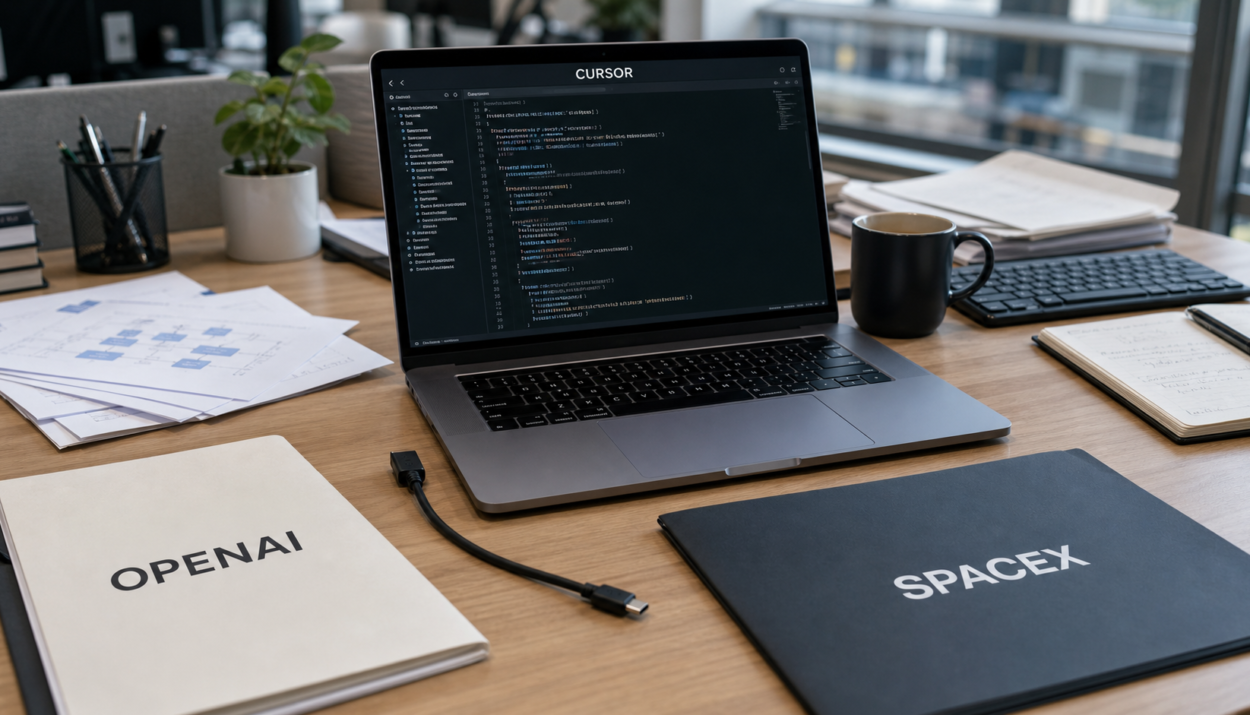

OpenAI plans to remove its models from Cursor after SpaceX acquired the programming assistant. The shutdown is proposed for November 12, 2026, and future OpenAI models should no longer be offered in Cursor, revealing the fragility of tools built on technologies belonging to their competitors.
Key points to remember
- OpenAI wants to terminate its model supply contract with Cursor, with a proposed cut-off date of November 12, 2026.
- The decision comes after SpaceX's official acquisition of Cursor, announced on August 14.
- OpenAI states that it cannot guarantee that SpaceX will comply with its terms of use. This justification represents OpenAI's position.
- Future OpenAI models, including Astra, are not expected to be available in Cursor.
- Cursor is now relying on SpaceX's computing infrastructure and Grok. to develop its own models and services.
OpenAI is preparing the end of its models in Cursor
The battle between OpenAI and Elon Musk's companies has just directly impacted one of the best-known development tools in the AI ecosystem. In a announcement published on August 28, OpenAI indicates that it has informed SpaceX of its intention to terminate the contract that allows Cursor to offer its models.
The proposed cut-off date is set for November 12, 2026. OpenAI explains that it is granting the maximum time allowed by the contract in order to give developers as much time as possible to continue using its models in Cursor and prepare for the transition.
The company clarifies, however, that it will not supply its future models to Cursor. It specifically cites Astra, an upcoming model whose advanced programming and cybersecurity capabilities, it argues, would require a higher level of contractual control.
Why the SpaceX acquisition changes the situation
Cursor a officially announced its acquisition by SpaceX on August 14th. The deal had been prepared several months in advance and valued the company at approximately $60 billion, according to Associated Press.
Cursor, developed by Anysphere, has established itself as a flagship tool for AI-assisted programming. Its interface allows developers to generate, modify, and analyze code using several model families, including those from OpenAI and Anthropic.
The change of ownership created a contractual window allowing OpenAI to terminate its agreement. SpaceX now encompasses several businesses linked to Elon Musk, including xAI, which develops Grok and directly competes with OpenAI.
OpenAI cites a risk of non-compliance with its rules
OpenAI justifies its decision by citing a lack of trust in the ability of Elon Musk's companies to respect its contracts and terms of service. The company refers to previous disputes with Twitter and xAI.
This explanation constitutes the official position of OpenAI. It should not be confused with a general court decision establishing that SpaceX necessarily intended to misuse the models in Cursor.
The split is also part of a broader conflict between Sam Altman and Elon Musk, the original co-founder of OpenAI who has become one of his main industrial and legal adversaries. With xAI, Grok, SpaceX, and now Cursor, Musk possesses a suite of technologies covering models, computing infrastructure, and developer access.
Cursor is now relying on Grok and the computing power of SpaceX
In its August 14 announcement, Cursor presents the acquisition as a way to access what it describes as the world's largest fleet of graphics processors. The company states its intention is to train more powerful and less expensive models to operate.
Cursor cites Grok 4.6 as a first glimpse of what the collaboration with SpaceX and xAI could produce. Its goal remains to develop agents capable of handling increasingly long and complex programming tasks.
The planned removal of OpenAI models does not mean the end of Cursor. Rather, it accelerates its transformation: from an interface bringing together the best models on the market to a product more integrated into Elon Musk's technological ecosystem.
What are the consequences for Cursor users?
Developers specifically using OpenAI models in Cursor will need to switch models, adopt a different tool, or use OpenAI's services directly. However, the actual impact will depend on the proportion of affected use cases and the availability of alternative solutions before November.
Cursor will be able to continue relying on its own models, on Grok, and, subject to their respective agreements, on other providers. However, OpenAI's decision reduces the available choice within the tool and demonstrates that a core feature can depend on a revocable contract between rival companies.
For companies that integrate programming assistants into their processes, this case serves as a reminder of the importance of planning for a replacement solution, assessing data portability, and not relying on a single model or platform.
The war of models is becoming a war of distribution
For several years, AI labs have sought to distribute their models in as many products as possible. Interfaces like Cursor offered a valuable showcase and acquisition channel for developers.
But as these interfaces develop their own models or come under the control of a competitor, distribution becomes strategic. Providing technology to a rival can help them attract users, gather feedback, and improve their own products.
OpenAI is willing to lose a distribution channel in order to retain more control over the use of its future models. SpaceX, for its part, gains a developer community and an immediate application for Grok through Cursor.
A warning to all companies using multiple AIs
This episode illustrates a structural weakness in applications built on external models. An interface may appear stable, but its capabilities depend on commercial contracts, pricing, security rules, and rivalries that are beyond the control of its users.
A sustainable AI strategy must therefore include the possibility of changing suppliers, isolating sensitive data, testing multiple models, and maintaining procedures capable of functioning in the event of a sudden disruption.
The announced end of OpenAI models in Cursor is not just another episode in the conflict between Sam Altman and Elon Musk. It shows that the next battle for AI will be fought as much over control of platforms and users as over the power of the models themselves.