


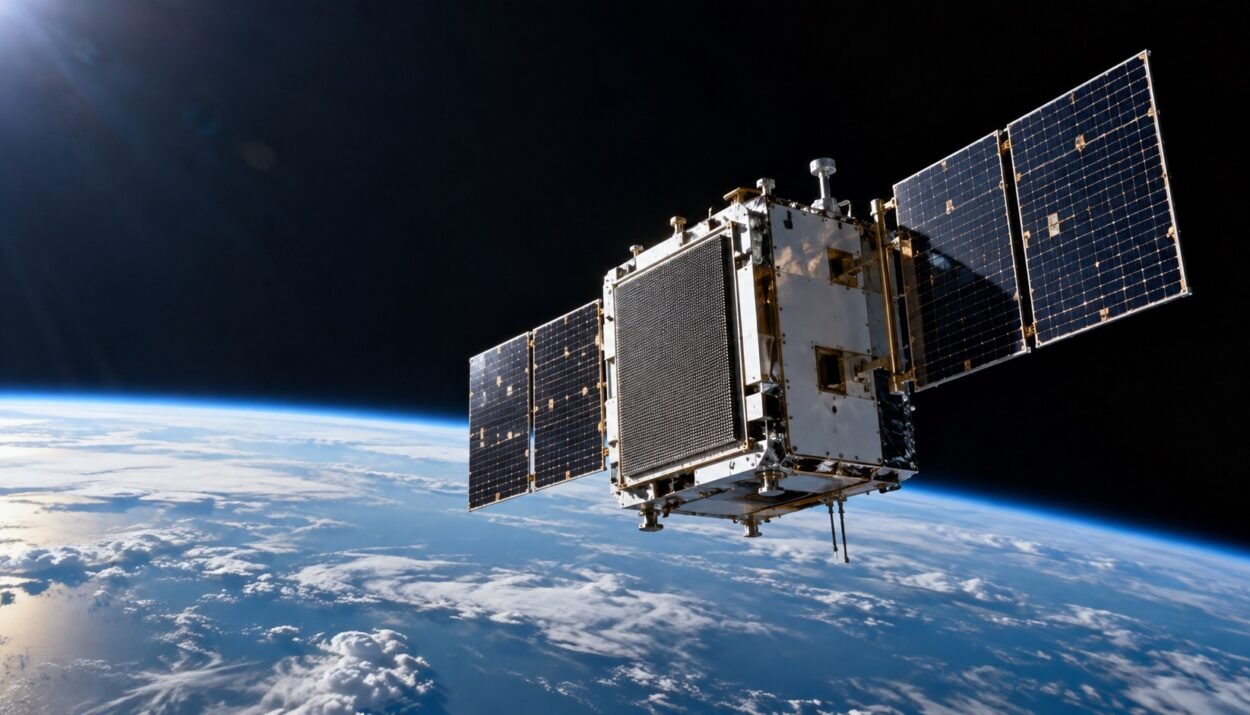

Google is preparing to send its first artificial intelligence chips into space. On October 1, 2026, an experimental satellite from Project Suncatcher is scheduled to launch aboard a SpaceX Falcon 9 rocket from California. The goal is not yet to operate a full-fledged orbital data center, but to test whether Google's TPU processors can withstand launch, radiation, temperature variations, and the vacuum of space. Behind this experiment lies a breathtaking idea: one day using constellations of satellites powered by the Sun to perform some of the calculations necessary for AI.
Key points to remember
- Google plans to launch an experimental satellite equipped with its TPU AI chips on October 1st.
- This mission is the first in-orbit test of Project Suncatcher, presented by Google in November 2025.
- The satellite must measure the resistance of components to launch, radiation and extreme temperatures.
- Google estimates that in low Earth orbit, solar panels could produce up to eight times more energy than comparable ground-based installations.
- The main obstacles remain cooling in a vacuum, communications between satellites, the cost of launches and maintenance.
- Orbital data centers could also increase the risks of collision, debris, and disruptions to astronomy.
What is Project Suncatcher?
Project Suncatcher is a Google research program designed to study the feasibility of installing, in the very long term, a computing infrastructure for artificial intelligence in low Earth orbit. The idea is to group satellites containing specialized chips and then link them via laser communications so that they work together like the servers of a ground-based data center.
Google already uses its Tensor Processing Units, or TPUs, in its own data centers to train and run artificial intelligence models. These chips are designed to perform the matrix calculations essential for neural networks very quickly. The space experiment aims to determine whether an adapted version can maintain reliable performance far from Earth.
The first device will therefore be neither a full-fledged supercomputer nor a publicly accessible "cloud in space." It is a technical demonstrator. Google wants to collect real-world data before considering more powerful satellites and, starting in 2027, testing high-speed communication between two spacecraft.
Why send AI chips into space?
Artificial intelligence consumes increasing amounts of electricity. Large data centers also require land, power grids capable of providing continuous power, and cooling systems that are often water-intensive. In several regions, their development is already causing tension with residents and grid operators.
In a sun-synchronous orbit, a satellite can remain exposed to the Sun almost constantly. Google estimates that its panels could then produce up to eight times more energy than comparable panels installed on Earth, because they would not be affected by night, clouds, or atmospheric absorption.
An orbital infrastructure could also directly process certain data produced in space, for example by observation satellites. Instead of transmitting massive volumes of raw images back to Earth, it could analyze them on-site and send only the useful results. This use case seems more realistic today than the rapid replacement of terrestrial data centers.
How should the satellite work?
The satellite will carry TPU chips and instruments designed to measure their behavior. During liftoff, the components will undergo intense vibrations. Once in orbit, they will be exposed to radiation, which can degrade the circuits or cause calculation errors known as "bit flips.".
The system must also dissipate heat. On Earth, data centers use air, water, or specialized liquids. In a vacuum, there is no airflow to carry away heat. Engineers must transfer it to radiators that dissipate it as infrared radiation. Google says it has already tested a combination of heat pipes and radiator panels in a chamber replicating space conditions.
Eventually, several satellites will exchange data via laser. The challenge lies in maintaining an extremely precise beam between objects moving at several kilometers per second. Without a high-speed connection, it would be impossible to efficiently distribute a large AI computation across multiple spacecraft.
What benefits can we realistically expect?
The main theoretical advantage is energy-related. A near-continuous solar power supply would reduce dependence on terrestrial electricity grids. The site also offers significantly more space than an industrial zone and avoids some of the land-use conflicts.
For observation, weather, telecommunications, or defense satellites, having computing power located near the sensors would allow for faster acquisition of usable information. AI could, for example, detect the start of a fire in an image, identify a climate anomaly, or intelligently compress data before transmission.
But these benefits remain prospective. The U.S. Government Accountability Office points out that large space-based data centers would require solar panels and thermal systems on a scale never before deployed. The first missions will primarily serve to identify the physical and economic limitations of the concept.
Why cooling might block everything
We sometimes imagine space as a naturally icy environment. This image is misleading. In a vacuum, equipment cannot cool itself by convection. All the heat produced by processors must be carried away to a radiating surface.
However, an AI chip can consume several hundred watts. When dozens of chips are deployed per satellite, the heatsinks become heavy and bulky. The larger the hardware, the more expensive its launch. This equation between computing power, cooling surface area, and mass will be one of the most important results of the experiment.
Are data centers truly more environmentally friendly?
While solar energy is abundant in orbit, this alone is not enough to automatically make the project environmentally friendly. Satellites must be manufactured, equipment must be launched regularly, faulty components must be replaced, and their end-of-life management must be handled.
A study published in 2026 in the Monthly Notices of the Royal Astronomical Society warns that very large constellations of data centers could disrupt astronomical observations and increase the risk of collisions. The European Space Agency also points out that the amount of objects and debris in orbit continues to grow.
A single prototype obviously does not represent the same threat as a constellation of thousands of satellites. But if the model were to become industrialized, the rules governing orbital traffic, deorbiting, and environmental responsibility would become central.
When will we see a true space-based data center?
Not tomorrow. Google presents Suncatcher as a long-term research project. The October 1st launch is only intended to verify the behavior of a small system. A second phase, dedicated to laser communications between satellites, is planned for 2027.
Available analyses differ on when profitability might be achieved. Launch costs still need to decrease, while the lifespan of the processors must be long enough to recoup their manufacturing and deployment costs. Updates and repairs pose another challenge: on Earth, a technician replaces a server. In space, each intervention becomes a complex operation.
The first commercial uses could therefore involve the processing of data already produced in orbit, before a possible extension to less urgent calculations intended for terrestrial users.
Our reading
Project Suncatcher is not yet the solution to the energy consumption of artificial intelligence. It is a concrete experiment designed to test whether an idea long associated with science fiction can overcome an initial technical hurdle.
The launch will be important, but the real information will come later: chip reliability, cooling efficiency, radiation-induced errors, and communication quality. If these results are encouraging, Google will launch a new industrial battle combining AI, semiconductors, energy, and space. Otherwise, Suncatcher will serve as a reminder that an abundant energy source is not enough to transform Earth's orbit into a computer center.
Frequently Asked Questions
Is Google already launching a complete data center in space?
No. The mission is carrying a prototype designed to test chips and equipment. An infrastructure capable of replacing a terrestrial data center remains a long-term research objective.
Why use TPU chips?
TPUs are processors developed by Google to accelerate the calculations needed for artificial intelligence. They already power the company's services and models in its terrestrial data centers.
Will Gemini's calculations soon be performed in space?
No commercial availability of this type has been announced. The prototype must first demonstrate that the hardware can operate sustainably in orbit.
Will the project really reduce the environmental impact of AI?
It's still impossible to say for sure. It could reduce some terrestrial energy or water needs, but the launches, manufacturing, debris, and end-of-life of satellites must be factored into the overall assessment.
To go further
- OpenAI Jalapeño: the results of its first AI chip
- Nvidia wants to turn your PC into the engine of your personal AI
Sources
- Google — Behind Project Suncatcher, September 24, 2026
- Google Research — initial project presentation, November 4, 2025
- The Verge — Google is sending an AI satellite into space next week, September 24, 2026
- The Register — technical analysis of the prototype, September 24, 2026
- US Government Accountability Office — Data Centers in Space, April 2026
- European Space Agency — Space Environment Report 2026
- Monthly Notices of the Royal Astronomical Society — Impact of Orbital Data Centers on Astronomy, 2026