


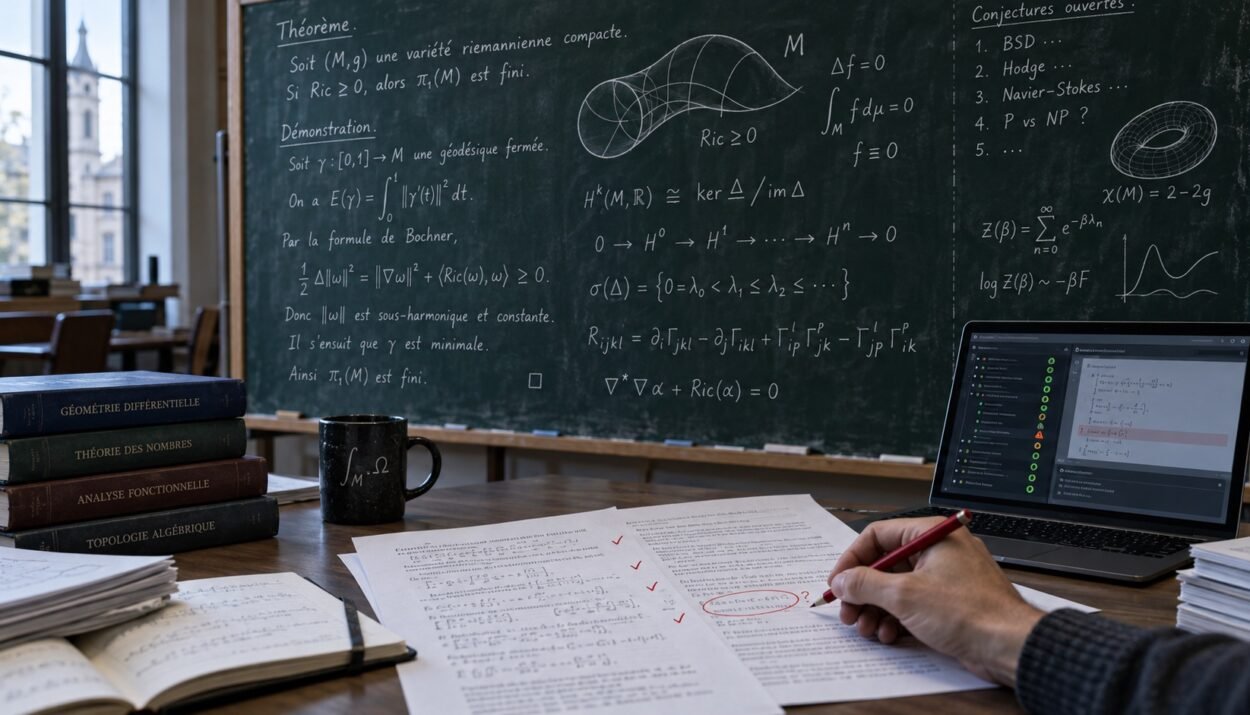

OpenAI claims that a new internal model has solved more than 100 mathematical problems that had remained unsolved for years. The company states that it began training the model on August 28, 2026, and acknowledges that the speed of its progress surprised even its own mathematicians. But "solving" a problem doesn't mean an announcement is enough: each proof must be published, understood, and validated by independent experts. So, are we witnessing a scientific breakthrough or a promise that is still difficult to assess?
Key points to remember
- OpenAI claims that its internal model has solved more than 100 open problems in several areas of mathematics.
- The company did not publish, in this announcement, the complete list of problems and all the corresponding demonstrations.
- A mathematical proof is considered established only after examination by independent specialists.
- OpenAI has created an advisory group bringing together researchers from major institutions, including ENS-PSL, the Collège de France, Cambridge, Oxford, Stanford and Harvard.
- This group is presented as independent, not paid by OpenAI and free to make its opinions public.
- If the results are confirmed, AI could accelerate basic research, but also revolutionize the rules of scientific attribution, publication and evaluation.
What does "solving a mathematical problem" mean?
An open problem is a question for which no one yet has an accepted proof. Some problems are easy to state but remain unsolved for decades. Others are so specialized that only a few researchers in the world can actually investigate a solution.
A convincing answer is not enough. A complete demonstration is required: a logical chain in which each step follows from the previous ones. If a single passage contains a hidden assumption, a misapplied definition, or circular reasoning, the whole argument can collapse.
This is why OpenAI's announcement should be read as a statement from the company, not as the definitive validation of 100 discoveries. Some solutions may be correct, others incomplete or less significant than the term "open problem" suggests.
How can an AI produce a demonstration?
A reasoning model can explore many avenues, use known theorems, test examples, and formulate a proposed proof. Several agents can work in parallel: some search for a strategy, others verify steps, identify a contradiction, or reformulate the result.
Formal tools like Lean then allow proofs to be represented in a computer-controlled language. The software mechanically verifies that each step adheres to the logical rules. This formalization reduces the risk of a convincing but flawed proof.
However, this doesn't solve everything. The problem may have been misinterpreted, the result may depend on a different hypothesis than the one investigated by the researchers, or the proof may be technically correct but less general than stated. Mathematicians therefore still need to understand the implications of the result.
Why is the announcement causing so much debate?
OpenAI claims that its model has also solved the Navier-Stokes problem, one of the seven Millennium Prize Problems defined by the Clay Mathematics Institute. The company has published a paper and a formalization, but specifies that it is not claiming the associated prize. Scientific validation of this magnitude cannot be achieved in a matter of days.
The company also acknowledges the concerns of some within the mathematical community. Researchers fear that AI labs will use open problems as mere testbeds, publish too quickly, or disrupt scientific credit standards. Proofs can rely on years of human work, intermediate conjectures, or discussions that are not always visible in the final data.
Who is responsible for verifying the results?
OpenAI announces the creation of an advisory group dedicated to mathematics and artificial intelligence. Its first members include Timothy Gowers, Edward Witten, Martin Hairer, Ravi Vakil and several other renowned researchers.
According to OpenAI, the group will be able to assess the scope of the results, advise on their dissemination, and publicly comment on the company's impact. Its members will not be paid by OpenAI. This structure can enhance the credibility of the process, but it does not replace peer review or the detailed publication of evidence.
Transparency will be crucial: a list of problems, precise statements, demonstrations, tools used, the proportion of human labor involved, and criticisms received. Without this information, the public cannot distinguish a historic breakthrough from an impressive but unverifiable figure.
What use is this in real life?
Fundamental mathematics often ends up influencing practical technologies. Number theory protects communications through cryptography. Differential equations describe fluids, climate, and blood circulation. Optimization improves logistics, energy, and networks.
An AI capable of proposing truly novel ideas could help researchers explore more hypotheses, formalize proofs, or connect disparate fields. It could also accelerate research in physics, materials science, biology, or theoretical computer science.
This doesn't mean AI will replace mathematicians. It's still necessary to choose the important questions, interpret the results, identify useful hypotheses, and decide how a discovery fits into existing knowledge. The tool primarily changes the number of avenues a team can explore.
Risks to watch out for
- The evidence appears solid but contains a subtle error.
- A race to advertise before the independent review.
- An insufficient attribution of previous human contributions.
- The publication of results that could accelerate sensitive uses, particularly in cryptography.
- A concentration of research around a few companies with very large computing capacities.
Our reading
The figure of 100 problems is spectacular, but the true revolution will only be confirmed once independent researchers have studied the evidence and explained its significance. The right question is not just "how many problems has AI solved?", but "which problems, using which methods, and with what validation?".
If a significant portion of the results withstand scrutiny, AI will reach a turning point: it will no longer be merely a tool for explaining science, but a system capable of contributing to it. This transition deserves more than a triumphalist title. It requires evidence, time, and appropriate scientific rules.
Frequently Asked Questions
Are the 100 problems officially considered solved?
No. OpenAI claims to have solved them, but the announcement does not contain the complete list and all the necessary independent validations.
Can a computer automatically verify evidence?
Yes, if the proof is translated into a formal language compatible with a tool like Lean. This verifies its logical consistency, but not automatically the importance or scientific scope of the result.
Is this AI available in ChatGPT?
OpenAI describes its internal model as still in training. The company has not announced its general availability in ChatGPT.