


TotalEnergies and the French company Mistral announce a joint three-year program representing more than 100 million euros. Their goal is to design artificial intelligence models specializing in subsurface analysis and oil and gas reservoir engineering. This news is significant for European industrial AI, but also controversial: the technology could improve knowledge of deposits and extend the lifespan of fossil fuel projects.
Key points to remember
- The program announced on September 15, 2026 represents over €100 million over three years, according to TotalEnergies.
- It extends a collaboration between the two companies announced in 2025; it is not a partnership born from scratch.
- The models should help geoscientists analyze large amounts of subsurface data and compare multiple exploration and development scenarios.
- A joint scientific laboratory will bring together specialists from TotalEnergies and Mistral.
- The announcement explicitly refers to the tanks. oil and gas, even though the two companies have also previously communicated on other uses of AI in energy.
- The announced gains remain objectives: no field results or final commercial model are presented in the press release.
What is the use of AI when searching for a reservoir?
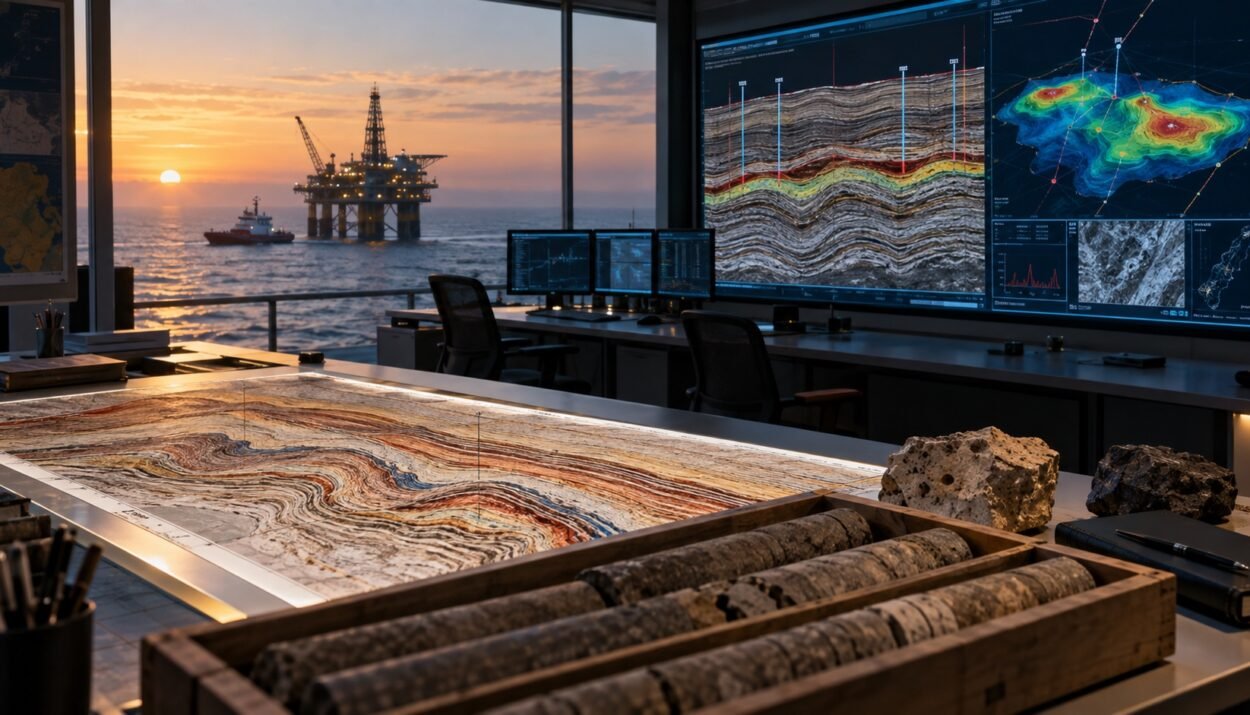
An oil or gas field is not a large empty pocket hidden underground. Hydrocarbons are present in porous rocks, the structure of which varies from place to place. To understand where they are located and how they circulate, geoscientists use seismic images, well measurements, rock analyses, and numerical models.
This information is massive and sometimes uncertain. The same dataset can correspond to several possible representations of the subsurface. Teams must therefore develop scenarios, test hypotheses, and compare the results with new measurements.
AI can help identify patterns in this data, link technical documents to measurements, and suggest interpretations for further investigation. An agent-based system could, for example, run multiple analyses, summarize the differences between scenarios, and highlight areas where information is lacking. However, the choice of drilling or investment remains a human decision, also based on risks, costs, and permits.
What TotalEnergies and Mistral want to build
According to their announcement, the program aims for a new generation of "boundary models" adapted to geosciences and reservoir engineering. Unlike a general-purpose chatbot, these models would be developed to work with data and questions specific to subsurface professions.
The two companies aim to combine TotalEnergies' accumulated expertise with Mistral's scientific capabilities in a joint laboratory. Their stated objective is to better characterize reservoirs, explore new avenues for development, and optimize or extend existing projects.
In practical terms, a geologist might ask what evidence supports a particular interpretation of a rock layer, what data contradicts it, and what additional surveys would be useful. An engineer might compare several ways to develop a reservoir, taking into account technical uncertainties. The potential benefit lies in the ability to quickly examine more scenarios—provided that the responses are traceable and verified.
The press release does not detail the expected performance, the exact evaluation methods, or the portion of the budget allocated to computing, teams, and infrastructure. Therefore, we must speak of a research and development program, not a tool whose effectiveness has already been demonstrated.
Why spend more than 100 million euros?
For TotalEnergies, a better understanding of the subsurface can have a significant impact on very costly industrial decisions. Misinterpretations can lead to drilling in the wrong place, overestimating a deposit, or designing a less efficient project than anticipated. Conversely, improved assumptions can help in selecting operations or managing an existing reservoir.
For Mistral, the agreement is an opportunity to prove that its models can go beyond simply writing texts or providing office support. The industry has complex data, security constraints, and experts who can verify the results. Success in this context would be an important benchmark for other sectors such as engineering, chemicals, and materials.
The partnership also illustrates the importance of digital sovereignty. TotalEnergies wants to maintain control over strategic data and have access to models tailored to its needs. Choosing a European partner can offer greater customization and contractual control. However, this doesn't automatically mean the entire infrastructure is European: it will be necessary to examine where the models are running and what technologies are being used.
The environmental angle that must not be ignored
The two companies have already communicated about the use of AI in a broader energy strategy. new program, This initiative explicitly targets the exploration and engineering of oil and gas reservoirs. It would be misleading to present it primarily as a renewable energy initiative.
AI could help limit certain unnecessary operations or improve the efficiency of a project. But the press release also indicates that it should help discover new exploration opportunities and extend the lifespan of existing projects. These effects could encourage the continued exploitation of fossil fuels.
The climate impact cannot therefore be deduced from the word "optimization" alone. It will depend on the projects actually carried out, the associated emissions, the savings achieved, and how the results are published. The energy consumed by training and using the models must also be taken into account.
What are the technical risks?
A model can detect a correlation without understanding its physical cause. It can also produce a convincing answer from incomplete data. In industry, an error isn't always corrected with a simple click: it can influence drilling, safety, or investment decisions.
The right question, therefore, is not "Can AI replace geologists?" but "Does it improve their decisions compared to current methods?" Demonstrating this would require tests on historical data, comparisons with existing tools, margins of uncertainty, and traceability of recommendations.
Our reading
This contract is an important test for French AI in a demanding industrial environment. Its value will be measured neither by the size of the budget nor by the stated power of the models, but by documented gains in solving problems that specialists are not currently able to address effectively.
Wazup will follow two questions: Will the models produce verifiable results that are useful to geoscientists? And what will be the real effect of these tools on fossil fuel activities and their emissions? Both answers are necessary to judge the program fairly.
Frequently Asked Questions
Are TotalEnergies and Mistral working together for the first time?
No. A broader collaboration was announced in June 2025. The September 2026 program adds an investment of more than €100 million over three years and a specific objective linked to oil and gas reservoirs.
Will AI find oil all by itself?
No. It can help to analyze data and compare hypotheses, but decisions are based on specialists, physical measurements, and economic and environmental assessments.
Is the program already operational?
The announcement presents a development project. It does not yet provide public validation demonstrating the performance of a final system.