

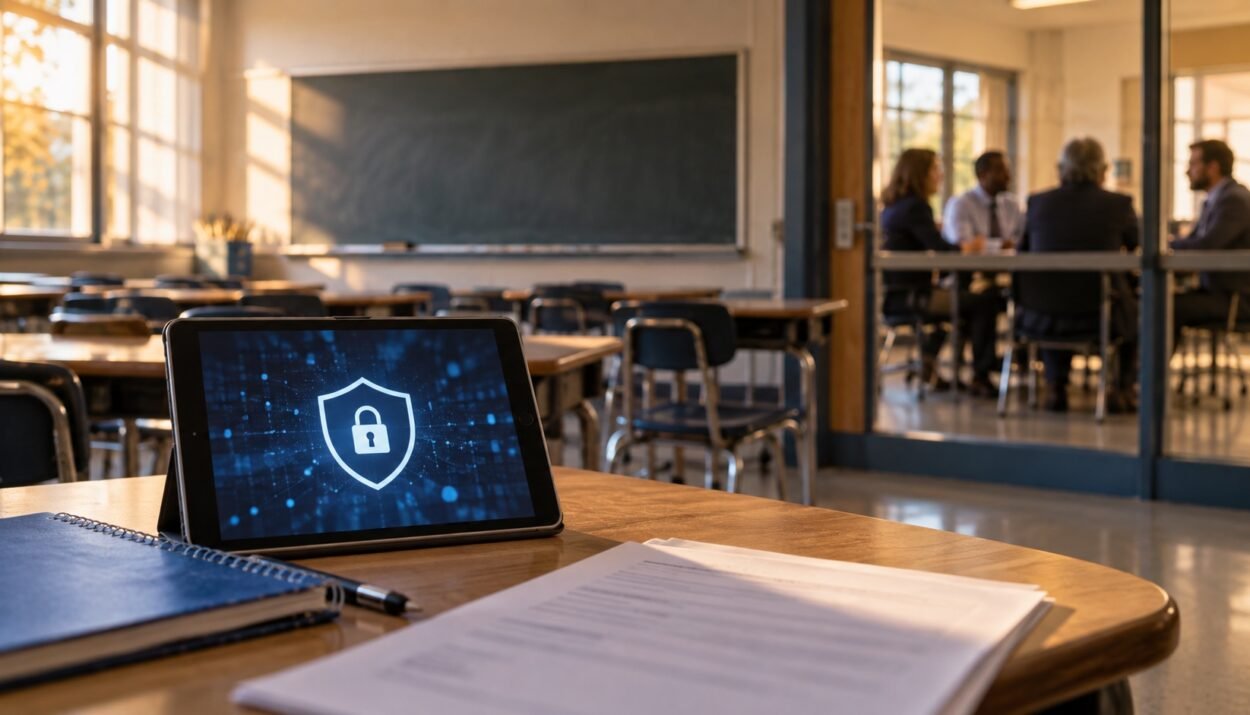

In the United States, Microsoft has reached an agreement with two teachers' organizations regarding the use of artificial intelligence in schools. For the relevant school districts and departments, the agreement stipulates, among other things, that student and teacher data will not be used to train AI models, with a limited exception related to security. It also regulates certain AI "companions" designed to create emotional dependence and maintains human control over important decisions. Widely reported in the American press, this agreement raises a question that also concerns French families: who protects children's conversations with school AI?
Key points to remember
- The agreement was announced on September 9, 2026 by Microsoft, the American Federation of Teachers (AFT) and the United Federation of Teachers (UFT).
- The text is signed within the framework of the National Academy for AI Instruction. American school districts They can request the integration of these protections into their contracts with Microsoft; this is not a French or European law.
- Student and teacher data must not be used to train AI models, except for the security exception provided for in the agreement, nor resold or used for advertising, according to the announced commitments.
- Schools must retain control over the use, storage, and deletion of data.
- Decisions concerning students should not be left to AI without human supervision.
- The agreement provides for transparency and means of control; its effectiveness will depend on its implementation and audits.
Why are schools negotiating with an AI company?
In a classroom, a digital assistant can explain a concept, suggest exercises, or help a teacher prepare a lesson. But it can also receive a student's mistakes, personal questions, school documents, and sometimes sensitive information about their situation.
This data is not simply a weather report. It concerns minors, in a context where school can make the use of such a tool practically indispensable. Parents and teachers therefore want to know who is reading the exchanges, how long they are kept, and whether they improve the company's models.
The debate has intensified in the United States with the introduction of AI features in educational software. The major school districts of New York and Los Angeles have decided to slow down certain uses intended for students while they assess the risks, reports the Associated Press. In this context, the AFT and UFT have negotiated contractual protections with Microsoft rather than relying solely on principles posted on a website.
What does the agreement stipulate?
The first protection concerns the’model training. An AI system can be improved through interaction examples. The announced agreement stipulates that student and teacher data will not be used for this purpose, subject to a limited exception related to student safety, as described by the Associated Press.
The second point concerns the purpose of the data. According to Microsoft and the unions, it must not be sold, reused for advertising, or diverted from its intended educational use. Schools must be able to control its storage and deletion.
The third point concerns the safety of the experience. The tools must not manipulate students or encourage them to remain engaged longer than necessary for learning. "Companion" type features that seek to create an emotional attachment are targeted by the restrictions reported by the Associated Press.
Finally, AI should not make important decisions on its own. Software can suggest a teaching approach, but a teacher or human administrator must remain able to understand, challenge, and correct a recommendation.
How can this protection work in practice?
A general promise is of little value if a school cannot verify what happens to the data. Therefore, organizations present the agreement as legally binding in contracts with U.S. school districts. These districts must be able to obtain clear, plain-language information about the products, their changes, and their risks.
Third-party audits are also planned, according to the Associated Press. Their role would be to verify that the company's practices align with its commitments: limited collection, no prohibited uses for training, sufficient security, and the ability to hold the company accountable. The full text specifies that the protections must be incorporated into the requesting district's agreement; it should not be assumed that every American school is automatically covered in the same way.
However, you will need to read the terms and conditions on a product-by-product basis. A commitment applied to Microsoft's school services does not automatically mean that all chatbots used personally by a student, on their phone or with a private account, benefit from the same rules.
What does this change for parents and teachers?
For the American families involved, the agreement could make the school's use of AI more transparent: what tools are used, what data is processed, and who to contact in case of a problem. For teachers, it affirms that AI remains a support tool and not a decision-maker in their place.
A simple example: a tool might suggest exercises tailored to a student struggling with fractions. But it shouldn't automatically conclude that this child needs to be steered towards a specific academic track, nor should it exploit their difficulties to train a commercial model.
For France, there is no no direct legal effect of this American agreement. However, the principle can be applied to the public debate: an institution should ask its AI providers for precise answers regarding training, data retention periods, access to data, audits, and human oversight. European regulations on personal data naturally add to these questions, without making the American agreement applicable in France.
The limits of a voluntary agreement
The agreement does not solve all the problems with AI in schools. It does not demonstrate that an assistant improves student performance, nor that it is suitable for all ages. It also does not address all of Microsoft's competitors.
The Associated Press reports that OpenAI and Anthropic were also discussing protections with the union, while no equivalent commitment from Google had been announced at the time of the report. Therefore, the text should not be presented as a standard already adopted by the entire industry.
Finally, there remains the question of educational dependency: even if data is protected, a school may decide that certain learning activities must take place without screens or assistants. Confidentiality and quality of teaching are two different criteria.
Our reading
The most interesting precedent is not technological, but contractual. American schools are trying to transform grand pronouncements about "responsible AI" into verifiable and enforceable obligations against a supplier.
For the general public, this is a useful reminder: asking whether an AI is effective isn't enough. We must ask what it does with the data, what decisions it influences, and who can control it. This analytical framework also applies to tools in healthcare, recruitment, or banking.
Frequently Asked Questions
Will Microsoft stop using all conversations to train its AI?
The announcement concerns student and teacher data within the context of the relevant school services. It does not allow for inferences regarding rules applicable to all Microsoft products or personal accounts.
Does the agreement apply to French schools?
No. It was negotiated for American school districts. French institutions must refer to the contracts that bind them to their suppliers and to the applicable law in France and the European Union.
Will students no longer be able to use AI?
The agreement is not a blanket ban. It regulates certain uses and leaves schools the choice of whether or not to deploy the tools in question.